Need 24/7 Service? Call for Emergency Repairs Call:
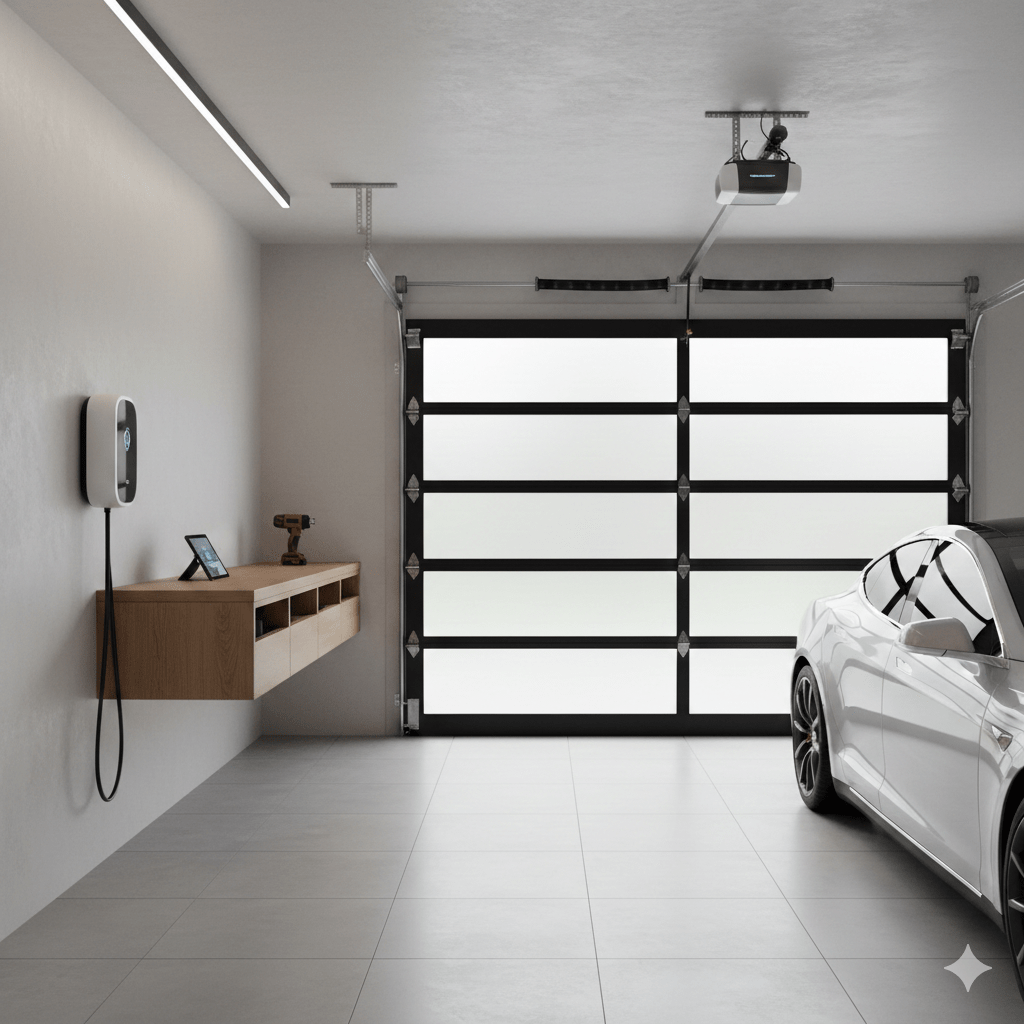
Upgrading Your Garage to Smart Tech: A Definitive Guide to Devices, Benefits, and How to Start
Yes — upgrading a garage to smart tech delivers measurable benefits: clearer security and monitoring, hands-free and remote access, safer package delivery, faster and smarter EV charging, and energy savings when paired with smart lighting and load management. Choose devices that match your priorities (security, EV charging, or simple convenience), verify interoperability, and install CO detection and proper ventilation as mandatory safety steps. Updated: February 10, 2026. (newsroom.myq.com)
This guide defines what a “smart garage” includes, compares core devices (openers, cameras, lighting, EV chargers, and environmental sensors), explains benefits and risks, and gives a practical 6-step upgrade plan plus example setups and cost ranges. Updated: February 10, 2026.
Quick answer — should you upgrade your garage to smart tech?
Yes. Smart garage upgrades typically improve security, convenience, and energy management. Prioritize safety (CO alarms and proper ventilation), verify vendor compatibility, and plan for subscription and local‑fallback behavior for critical systems.
What “smart garage” means (definitions & categories)
Quick definition: A smart garage uses connected devices—openers/controllers, cameras and sensors, smart switches/plugs, EV chargers, and environmental monitors—so you can automate, monitor, and control the garage remotely or by voice. Typical goals: secure access, package protection, safe EV charging, and energy‑efficient lighting.
Smart garage door openers & controllers
What they are: Full replacement openers (for example LiftMaster, Chamberlain, Genie, Ryobi, Kwikset) or retrofit controllers and bridges that add app/voice control to an existing opener.
Why they matter: remote open/close, activity logs, and integrations with delivery services like Amazon Key In‑Garage Delivery. Note: some major brands are tightening control over integrations; Chamberlain/myQ recently restricted certain third‑party controllers—check compatibility before buying.
Cameras and sensors
Use cases: live feed, motion alerts, package detection, two‑way talk, and automation triggers (for example: turn on lights when the door opens). Choose weather‑resistant outdoor cameras for outside coverage and rugged indoor/garage‑rated cameras for inside. Consider trade‑offs between cloud subscriptions and local storage (Arlo, Ring).
Smart lighting and outlets
Benefits: motion‑triggered lights, energy savings, better visibility. Use garage‑rated fixtures or smart outdoor plugs/switches. Popular options include Philips Hue, LIFX, Meross, and Matter‑capable bulbs and switches listed on Matter Catalog.
EV chargers and power management
Options: hardwired Level‑2 home chargers from brands like ChargePoint, Wallbox, and Tesla. Smart chargers offer scheduling, rate‑based charging, and power monitoring. Don’t rely solely on cloud‑dependent features—confirm fallback behavior if vendor services end. See home charger roundups for comparisons. (ev.com)
Air quality, CO detection, and ventilation
Critical safety items: carbon monoxide (CO) alarms and proper ventilation. Never run a vehicle in a closed garage; CO can become deadly quickly. Install CO alarms on every level and follow placement guidance from the EPA, CDC, and CPSC.
Access and integration (apps, voice assistants, Matter)
Ecosystems include Amazon Alexa, Google Home, Apple Home, and SmartThings. Matter and Thread improve cross‑vendor compatibility; newer devices from SwitchBot, Kwikset, and Aqara are adopting Matter—still verify opener compatibility because dominant suppliers sometimes lock down integrations.
Key benefits (security, convenience, energy, safety, EV readiness)
-
Security and theft prevention
Smart cameras and smart openers reduce theft and unauthorized entry. Built‑in camera openers and add‑on camera systems provide live views, two‑way audio, and event logs; services like Amazon Key use verified driver access so packages can be placed inside garages (LiftMaster Secure View).
-
Convenience and time savings
Remote open/close, vehicle detection, voice control, and integrations with car platforms reduce friction. Many openers operate through apps and voice assistants; some integrate with CarPlay/Android Auto. (HomeKit.blog)
-
EV readiness and energy efficiency
Smart chargers optimize charging times and costs. Home chargers such as ChargePoint and Wallbox offer scheduling and load features; vendor shutdowns (e.g., the JuiceBox/Enel X Way reporting) show dependencies on vendor services can disrupt app features.
-
Safety (CO and ventilation)
CO alarms and proper ventilation prevent deadly exposures. The EPA/CDC/CPSC warn against running vehicles inside garages and recommend CO alarms on every level. (EPA)
What to watch out for (compatibility, subscriptions, privacy, safety)
- Locked ecosystems and compatibility changes: Some vendors change integration rules—verify support for your voice/home platform. (The Verge)
- Recurring subscription costs: Camera cloud storage and AI detection often require monthly fees—factor them into long‑term cost. (The Verge on Arlo)
- Cloud dependence and vendor shutdowns: Features can disappear if a vendor discontinues service—choose devices with local controls. (The Verge)
- Safety blind spots: Don’t skip CO detection, hardwired electrical safety, or licensed electrician work for hardwired chargers.
A practical 6-step upgrade plan (budget-friendly to pro)
- Prioritize safety: install or test carbon monoxide detectors and hardwired smoke detectors. (Day 0). (EPA)
- Add smart lighting and motion sensors: inexpensive, immediate ROI for safety and convenience. (Week 1)
- Choose a garage door strategy: retrofit controller for budget + compatibility, or replace with a smart opener (LiftMaster / Genie / Kwikset) if you want built‑in features. Verify integrations. (Week 2–4). (LiftMaster)
- Install cameras where they matter: one covering the driveway/door and one inside the garage aimed at access points. Confirm storage plan (local vs cloud). (Week 3)
- Plan for EV charging and power: consult an electrician; pick a smart charger with local controls and load‑management if you plan charging during peak rates. (Week 4–8). (ev.com)
- Automate and lock down: create automations (close door after X minutes, lights on when motion detected), share access securely, and review logs monthly. (Month 2 onward)
Example setups for common needs (basic, security-first, EV-ready)
Basic convenience
Smart plug for overhead light, Meross‑style Wi‑Fi opener remote, one indoor camera. Cost: ~$100–300. (Meross)
Security‑first
LiftMaster Secure View opener (camera & two‑way audio) + two outdoor cameras + CO monitor. Cost: $600–1,500. (LiftMaster)
EV‑ready
Dedicated Level‑2 charger (ChargePoint/Wallbox/Tesla) + load management + garage opener + cameras. Expect electrician costs + $700–1,500 for charger hardware. (ev.com)
Short micro‑story (real‑world context)
Here’s the truth: a homeowner I advised last summer installed a Secure View opener and one indoor camera. After enabling automated rules, she stopped getting “did I close the garage?” anxiety, caught a contractor who left the door open once via the app logs, and used Amazon’s in‑garage delivery twice during vacations—saving two packages from porch theft. The cost was recouped quickly in avoided losses and fewer emergency calls. (newsroom.myq.com)
Costs, ROI, and final checklist
Cost ranges: entry smart upgrades $100–300; full smart opener + cameras $600–2,000; EV + electrical work $2,000–5,000 depending on panel upgrades.
ROI drivers: prevented theft, saved time, energy savings from lighting/charger scheduling, and increased home value for tech‑friendly buyers.
- Confirm compatibility with your ecosystem.
- Verify fallback/local controls if vendor cloud goes away.
- Include CO alarm and electrical inspection for chargers.
- Budget for subscriptions if you want cloud AI features.
Sources and next steps
- LiftMaster Secure View product info / myQ newsroom. (liftmaster.com)
- Amazon Key In‑Garage Delivery overview and eligibility. (aboutamazon.com)
- The Verge coverage of Chamberlain/myQ integration changes. (theverge.com)
- EPA / CDC / CPSC guidance on carbon monoxide safety and detector placement. (epa.gov)
- EV charger guides and notes on vendor app risk (ChargePoint, Wallbox; JuiceBox/Enel X Way reporting). (ev.com)
- Matter and interoperability progress (SwitchBot, Kwikset, Aqara). (matteralpha.com)